
What your team still controls
Dispatchers check the costs and offer details, choose which offers to accept and retain responsibility for customer and carrier agreements.
The situation
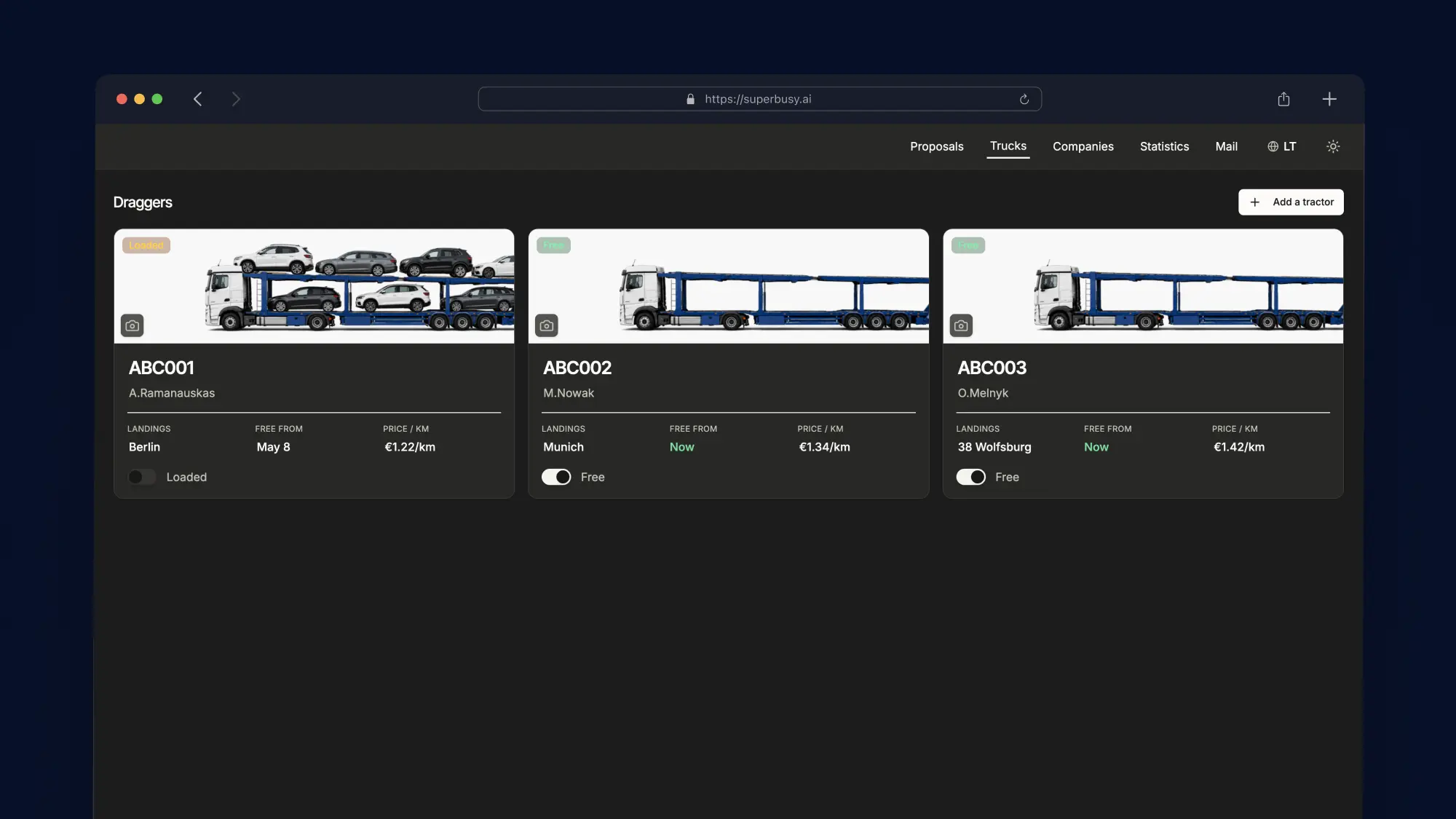
A road freight operator running three trucks was sourcing cargo the way most small fleet operators do — through a mix of broker emails, phone calls, and WhatsApp messages. The dispatcher’s morning started with an inbox full of offers in different formats from ten or more companies, each requiring the same manual sequence: open the email, find the price and route, open a maps tab to check where the nearest truck was, estimate the empty kilometres to the pickup, do the multiplication, write the margin on a notepad, move to the next email.
On a busy day with 30 to 50 offers arriving before noon, that process was slow enough that good jobs were gone by the time the calculation was done. There was no record of what was reviewed, no way to compare offers side by side, and no visibility into which brokers consistently paid well. The cost of being second was a less profitable load or an empty truck.
What we built
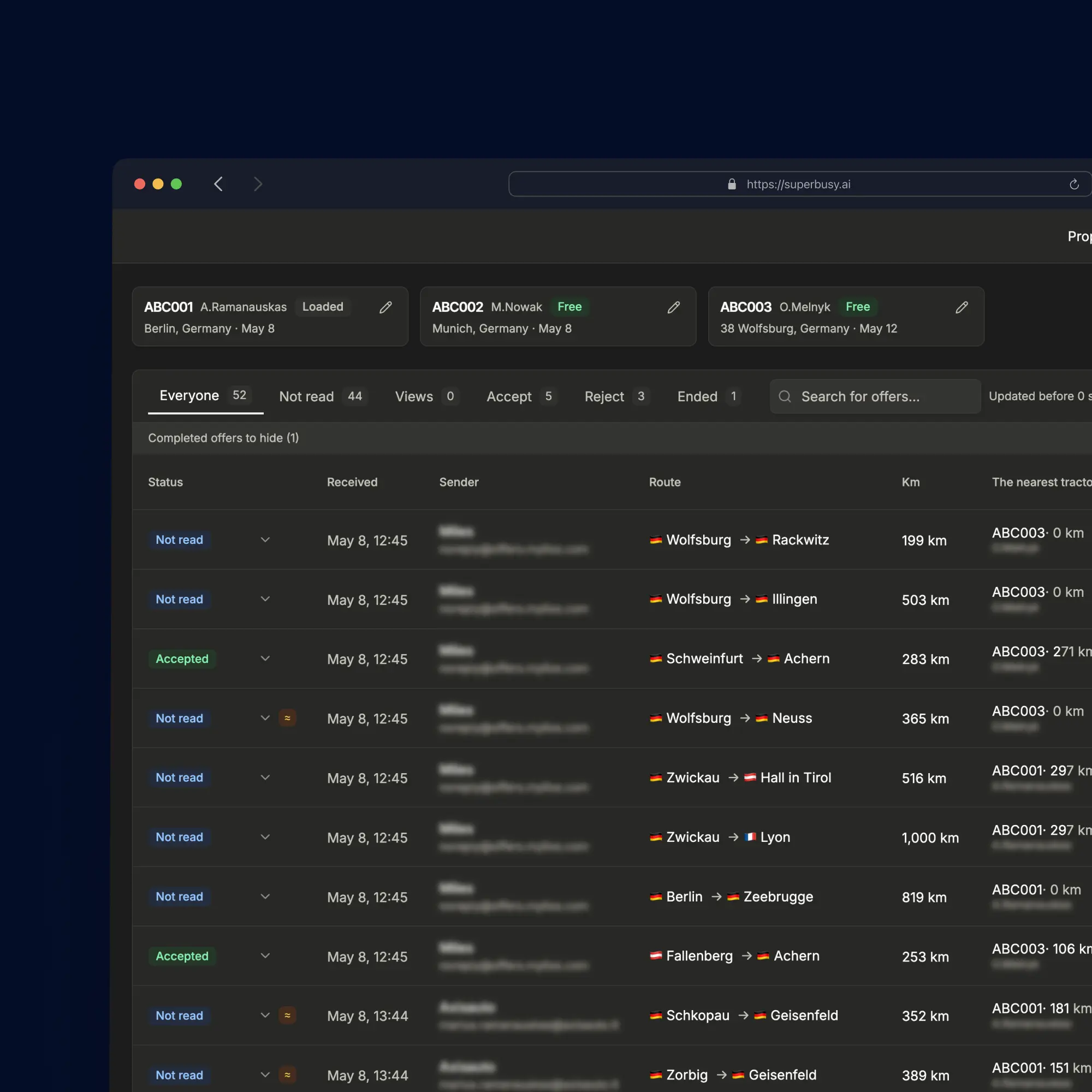
We built a web-based cargo offer management tool. The dispatcher sets up a single forwarding rule in their existing email client — nothing changes for the brokers. Every offer email that arrives gets forwarded to a private address, where an AI reads it, extracts the route, price, available date, vehicle requirements, and any special conditions, and creates a structured offer row automatically. One email containing eight routes becomes eight individual rows. Multi-leg and round-trip routes are identified and stored correctly.
For each offer, the tool calculates the full cost per truck: route kilometres plus the empty kilometres the truck needs to drive from its current location to the pickup, multiplied by that truck’s cost per kilometre. The net margin — in euros and as a percentage — appears in the table before the dispatcher opens a single email.
The dispatcher sees one sorted table. They filter by pickup country, sort by margin, spot the best three jobs for the day, and confirm them. Offers received by phone or WhatsApp can be added manually and appear alongside email-parsed ones.
A typical morning: 40 offers arrive between 7 and 10 AM. The dispatcher opens the tool, sorts by margin, reviews the top ten, assigns the three best jobs to the right trucks, and marks the rest as rejected or reviewing — all from a single screen.
The decisions that mattered
Forward emails rather than integrate with brokers
Getting brokers to change their process was never realistic. We built the tool to work with emails they already send. One forwarding rule in any standard email client is the entire setup. No new accounts, no new platforms, no change in how brokers work.
Include deadhead kilometres in every margin calculation
The agreed price is only half the number that matters. The true cost includes the empty kilometres a truck must drive to reach the pickup — and that figure varies per truck, per offer. Without it, margin looks better than it is and the wrong jobs get taken. We made this calculation automatic for every truck on every offer, so the dispatcher never needs to look it up manually.
Build a sender profile for each broker
Brokers and logistics companies write emails differently — different formats, different languages, different notations for routes, vehicle types, and prices. Rather than treating all emails the same, the tool learns each sender’s format over time and applies those rules to future emails from the same source. Accuracy improves with each new email from a known sender.
Allow manual entry alongside parsed offers
Not all cargo comes by email. Deals made by phone or WhatsApp would create a gap in the data if they couldn’t be recorded. We added a manual entry form so every job the company takes appears in the margin calculations and performance statistics — giving the fleet owner an accurate picture of the business, not just the email-sourced portion of it.
What changed
The dispatcher’s morning process is now built around one screen. Offers are waiting in a sorted table when they arrive, with margins already calculated. The sequence that previously took around four minutes per offer — open email, find details, check map, calculate, record result — now takes around ninety seconds, and most of that time is the decision itself, not the preparation for it.
Across 30 to 50 daily offers, that reduction compounds quickly. The dispatcher reviews more offers in less time, responds faster to the best ones, and has a record of every decision made.
The practical effect is that the best jobs get confirmed earlier in the day, before other operators have finished calculating. For the fleet owner, the statistics view shows which trucks are earning, which routes perform, and which broker relationships are worth maintaining — without any additional work from the dispatcher.
| Metric | Before | After | Change and period |
|---|---|---|---|
| Time to evaluate one offer | Around 4 minutes | Around 90 seconds | 63% less time per offer |
| Offers with full margin visible before decision | 0% | 100% | Full margin visible for each offer |
| Time to review full daily inbox (40 offers) | Around 2 hours 40 minutes | Around 1 hour | 63% less time per daily review |